

One of the pillars to your website getting a good performance is UX, or User Experience. The design and usability of web pages are essential so that customers can have a good experience.
Providing a poor experience can result in frustrated customers, a bad perception of the business brand, and increased costs, so, everyone that looks to build a digital project needs to be aware to develop a good UX design.

What is UX?
UX acronym stands for User Experience, what the users feel when interacting with a service, a system, or a product. This process will design a strategy that prioritizes a good experience for those who interact with the software, from the study of their needs, their behavior, and their motivations.
The objective of UX is to design an interface with an interaction that is as pleasant as possible, designing platforms and points of contact that allow the user to interpret easily, more intuitively, and simply, on their own.
Why worry about your website’s UX?
A visitor is not willing to spend more than 59 seconds on a website, being necessary to turn your website faster possible in terms of server processing and layout disposition.
Design a website with a good experience will provide your company:
- Retain visitors
A more attractive and easy-to-navigate website invites the user to stay there, either with interesting content or by offering other pages to browse. Thus, the time spent on the site is increased, guiding the user to discover other available content.
- Increases the perceived value of the product
Provide an experience that, after a purchase, arouses a positive feeling in the user, accompanied by a “Wow, this purchase was worth it!” its added value, which goes beyond its monetary cost.
- Loyalty and referrals
Promoting an incredible experience for your consumer means making this customer someone loyal to the brand, who, when they feel the need for a new purchase, will have kept in their memory the pleasant feeling that your company left in their interaction, making a recurring purchase.
In addition, it will create an advocate for your brand, who may be guided to refer you to friends, family, and acquaintances.
- Increase in conversions
The decision to make a purchase, sign up, or contact, is built while the visitor walks through your website, so if the user feels comfortable browsing, the probability for a conversion action increases.
So, having good navigation between products, knowing where and when to display forms, and newsletter subscriptions, are more likely to convert.
What should I consider for a good UX?
- The loading speed
Waiting more than 4 seconds for the page to load can represent the loss of countless sales and other conversions, so it the importance of worrying about the loading time of your website.
The tip is to opt for a minimalist layout, without many images, and replace, for example, a jpeg file with a webp, which can reduce the image size by up to 35% without losing quality.
- The menu
Your site’s menu also directly impacts performance and user experience. Take into account whether the links to the pages are clearly organized or have broken links.
Another element is to verify that the accessibility of the menu on a smartphone is as good as on a computer, especially considering that a large part of access is currently via cell phones.
- Search bar
The search bar is an essential tool for a good user experience and should be positioned in places that facilitate user access and interaction.
What steps to follow to develop UX?
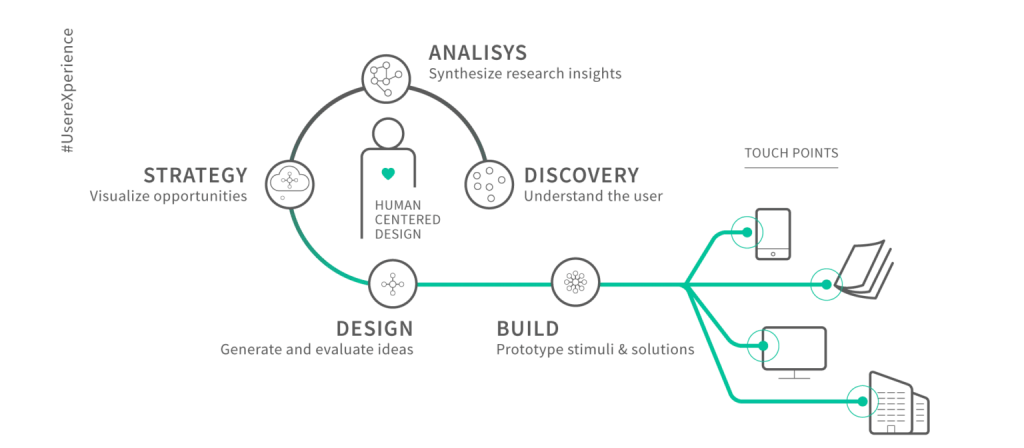
The first step in building UX is collecting data, knowing what the likes, needs, desires, and limitations of the visitors are. Knowing your audience’s persona and the market makes it easier to measure what your user is looking for.
2. Create Your Audience Persona
After having knowledge of the audience and their needs, it is time to move on to the creation of the persona, which is the representation of the entire target audience of the company, developing a project that can reach several people that fit the same characteristics.
3. Designing the UX
The next step is to create a sitemap to understand the best layout and layout of the contents so that the flow of user interaction on the site is the best possible.
Get in mind that we are driven to make decisions according to our feelings and emotions, the UX must awaken the user’s feelings while browsing, these emotions are based on affective, sensory, experiential, meaningful, and valuable elements of human-computer interaction (HCI).
4. Usability testing
The fourth step consists of verifying the prototype of the project, seeking to identify the number of errors that the user may make during the test, and measuring customer satisfaction through user feedback, A/B tests, heat maps, and other tools.
5. Validation
The last step is to analyze the results. After launching the prototype on the market, the site’s indicators must be monitored, in order to intervene in points where usability can be improved.
Zoom out: There is no absolute guide of steps to develop the UX, the phases can be different according to each designer or team, which according to the needs of your project, can follow different steps.
UX examples from very famous companies
Amazon
Amazon is a marketplace that offers numerous products for the most diverse consumer needs, and precisely because of the large number of products and segments, it becomes a challenge to create a platform with a structure that does not make the user get lost in the process of purchase.
Using the UX, Amazon bet on a simple Home Page, focusing on the subdivision of categories and an easy-to-interact search field, so that the user can easily search. With this structure, Amazon made it possible for your user to be on the purchase page of the product you want in just 3 clicks.
Another innovation was the feedback and review field, which made it possible for buyers to publicly share their vision of the product, influencing the purchase of other users.
TripAdvisor
TripAdvisor is one of the most famous travel reviews and price comparison sites, which has also done a great job focusing on its user experience.
Tripadvisor focused on making a Home Page focused on just a single action, where the user enters the desired destination in a highlighted section right at the beginning with the call “Where to?”.
Quickly, the user is already on a page with offers of hotels, restaurants, and experiences that he can do in his destination, being ranked according to the best possible offers, having the functionality to filter his search to obtain results with greater precision.
Why is UX essential for Marketing?
It is very common to see companies treating UX and Marketing as two different sectors, but the truth is that both must always be integrated, combining and structuring strategies together, because UX is embedded in the product or service you want to sell.
Providing your customers with a delightful emotional experience during their purchase process, making them quickly find your product and its benefits makes it more conducive to purchase, referral, and word-of-mouth marketing.
 Luan Fereguetti